How To Add PowerShell v7 Preview to the New Windows Terminal

In this quick post I’ll show you how to add PowerShell v7 stable and preview releases to the new Windows Terminal.

<Update 2020-07-20>Originally this post was written for PowerShell v7.0.0-preview.1 before it was generally available. Since that time PowerShell v7 now has stable releases but continues with preview releases as well. I’m updating this post to reflect how you can add stable and preview releases side-by-side in Windows Terminal.</Update>

Background

The new Windows Terminal was announced at Build this year and has been available (building from source code yourself) through the Microsoft/Terminal GitHub repo.  A very early preview of the Windows Terminal is now available through the Microsoft Store (link).  I haven’t verified but I believe you’ll need a few prerequisites in order to install.  Out of the box the current preview of Windows Terminal supports a number of shells including:

  • PowerShell (v6, also known as “PowerShell Core”, and v7)
  • Windows PowerShell (v5)
  • CMD (command prompt)
  • WSL (Windows Sub-system for Linux)
  • Azure Cloud Shell
  • and more…

Dynamic Profiles

By default, Windows Terminal now uses a feature called “dynamic profiles” to automatically generate profiles for any of the following shells on your machine:

  • PowerShell
  • WSL
  • Azure Cloud Shell

At any time, you can remove (or rename if you want to keep a copy) the settings.json file used by Windows Terminal. This will force auto-generation of a new settings.json file so that you can see which shells it finds. Read more in the support article on this topic.

Dynamic profiles in Windows Terminal
https://docs.microsoft.com/en-us/windows/terminal/dynamic-profiles

Solution

After installing the Windows Terminal from the Microsoft Store, open the Settings from the dropdown menu (or click “Ctrl + ,”).

Find the “profiles” element in the settings file and add the following JSON snippet to the array.  Verify the “commandline” and “icon” locations match where PowerShell v7 preview is installed on your machine.

{
    "guid": "{574e775e-4f2a-5b96-ac1e-a2962a402336}",
    "name": "PowerShell 7",
    "fontFace" : "Cascadia Code PL",
    "source": "Windows.Terminal.PowershellCore",
    "hidden": false
},
{
    "commandline" : "C:\\Program Files\\PowerShell\\7-preview\\pwsh.exe",
    "fontFace" : "Cascadia Code PL",
    "guid" : "{90cbdc15-f4fe-49d2-a245-ec066b70845f}",
    "icon" : "C:\\Program Files\\PowerShell\\7-preview\\assets\\Powershell_av_colors.ico",
    "name" : "PowerShell 7 preview",
    "startingDirectory" : "%USERPROFILE%",
    "hidden": false
},

Here is a link to my complete profiles.json for comparison.

After you’ve added the above element you’ll now see PowerShell v7 preview in your dropdown list of available shells with the proper icon.

Below screenshot shows PowerShell v7 Preview in use and verifying the PSVersion.

Bonus – Zsh and Oh My Zsh

For an added bonus I also added Zsh (with the Oh My Zsh framework for auto-suggestions and more) based on seeing demos from Jeff Hollan showcasing that shell.

Bonus – Cascadia Code PL

You may have noticed from the samples above that my shell profiles are using fontFace of “Cascadia Code PL”. Cascadia Code is a new font from Microsoft that was developed alongside Windows Terminal. The “PL” (Powerline) variant includes ligatures that take combinations of characters and convert them into glyphs. This is best demonstrated when you view the following documentation to see a sample. Note that there is some additional work (link) to configure this on your machine.

Cascadia Code
https://docs.microsoft.com/en-us/windows/terminal/cascadia-code

Conclusion

I’m very excited to begin using the Windows Terminal more in my daily tasks.  Being able to switch back and forth between multiple shells (specifically PowerShell v5 and v6/v7) is possible in Visual Studio Code but this will be a much easier solution for many of my scenarios.  Hopefully someone else will find this helpful as well.

-Frog Out
How To Self Destruct Azure Resource Groups with Alert and Logic App

I was reading a blog post by Mark Heath on This resource group will self destruct in 30 minutes which leverages an open source Azure CLI extension to automatically delete resource groups.  This extension accomplishes the deletion by scheduling a logic app in the same resource group.  I was curious if I could accomplish the same effect without the need to leverage the Azure CLI (i.e. for any resource group created via portal, PowerShell, etc.)  In this post I’ll show how to configure a “self destruct” mechanism using an Azure Alert and a Logic App.

Solution

Here are the high level steps to follow.

  1. Create Resource Group – Create resource group will host the subsequent resources
  2. Create Logic App – Create logic app to trigger on Azure Activity Log HTTP request (will fill out more later)
  3. Activity Log alert – Create Azure Activity Log alert to trigger logic app
  4. Trigger Alert – Create resource group which triggers Activity Log alert and consequently logic app
  5. Gather JSON schema – Get JSON schema for HTTP request sent to logic app
  6. Finalize Logic App – Add JSON schema from alert HTTP request and action to remove resource group to logic app

1) Create Resource Group

If you don’t already have one, create a resource group to host the resources for the self destruct solution.

2) Create Logic App

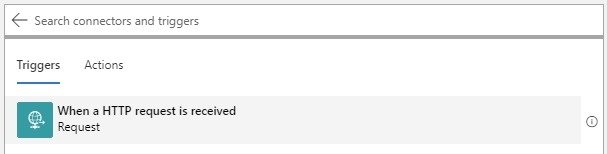
Create a logic app in the resource group from previous step.  Add a trigger for When a HTTP request is received.  We will not fill out any of the details for the trigger at this time.  Click Save.

AzureRGSelfDestruct8.jpg

3) Activity Log alert

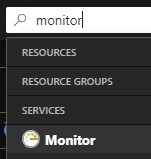
Navigate to Azure Monitor (can search from the top search bar or go through All Services) for the subscription where the solution will be deployed.

AzureRGSelfDestruct10.jpg

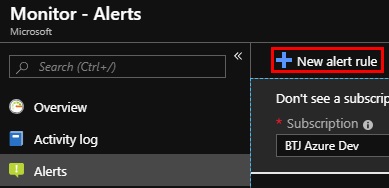
Click Alerts on the left hand navigation.  Click New Alert Rule.

AzureRGSelfDestruct11

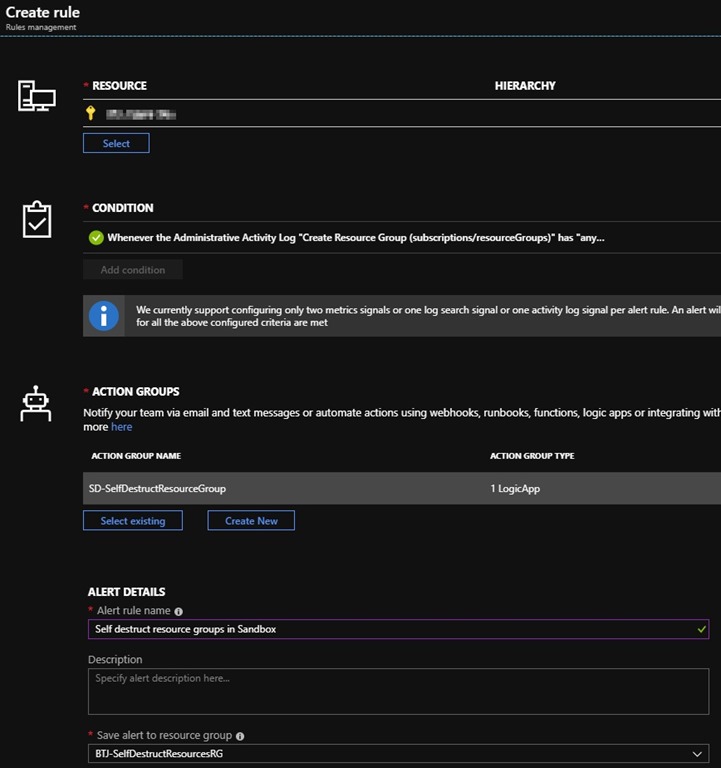
Define the resource to be monitored:

  • Resource:
  • Condition:
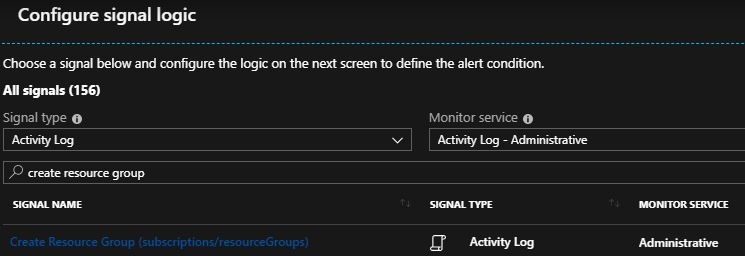
    • Signal Type: Activity Log
    • Monitor Service: Activity Log – Administrative
    • Signal Name: Create Resource Group (subscriptions/resourceGroups)
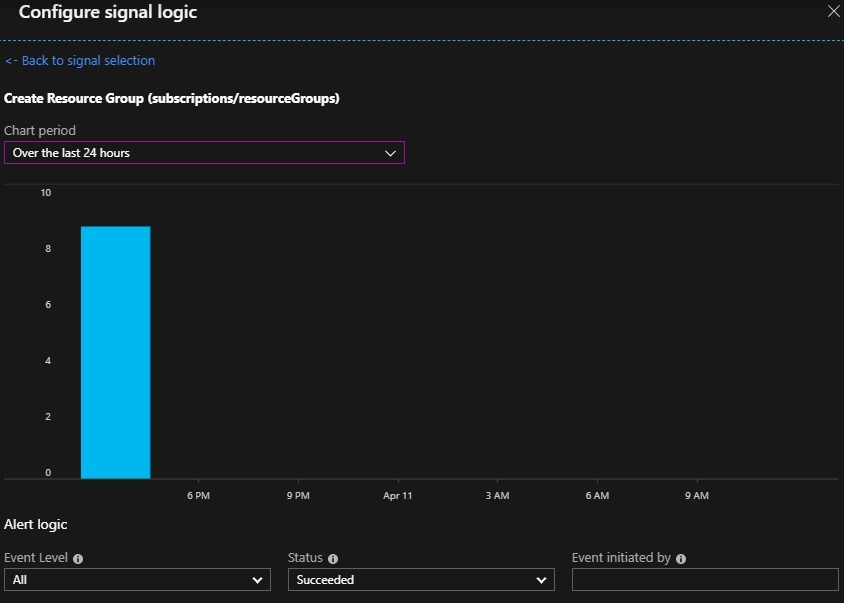
    • Alert Logic – Status: Succeeded
  • Action Groups:
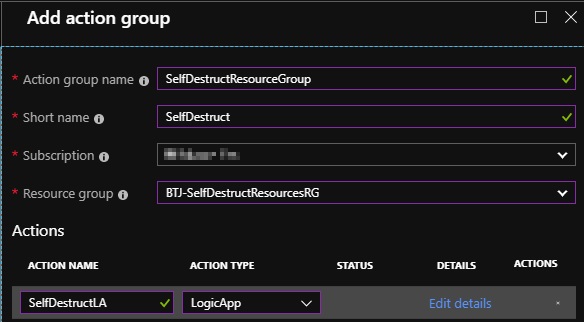
    • Action Group Name: SelfDestructResourceGroup
    • Short Name: SelfDestruct
    • Subscription:
    • Resource Group:
    • Action Group Action: LogicApp
      • Subscription:
      • Resource Group:
      • Logic App:

AzureRGSelfDestruct2.jpg
Condition – configure signal logic part 1

AzureRGSelfDestruct3.jpg
Condition – configure signal logic part 2

AzureRGSelfDestruct13
Create new alert action group with a logic app action

AzureRGSelfDestruct4.jpg
Create a new alert action to go in action group

AzureRGSelfDestruct5.jpg
Overview screenshot for rule creation

4) Trigger Alert

Create a new resource group that will then trigger the alert defined in step 3 and consequently fire the HTTP trigger for the logic app defined in step 2.

5) Gather JSON Schema

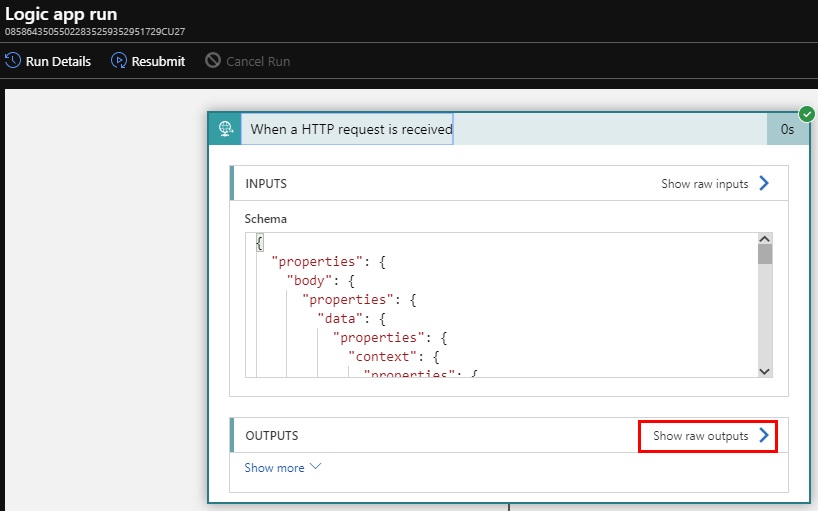
Navigate to the logic app defined in step 2.  Assuming the logic app was successfully triggered, under Run history select the successful logic app execution.  On the “logic app run” screen expand the trigger and click on Show raw outputs.

AzureRGSelfDestruct14

Save this JSON for use in the next step.  If you are unable to collect this JSON schema you can use the sample below which is already coverted to the final format needed.

Note: the resoureceGroupName element is buried many levels deep.  We will query for this when needed.

{
“properties”: {
“body”: {
“properties”: {
“data”: {
“properties”: {
“context”: {
“properties”: {
“activityLog”: {
“properties”: {
“authorization”: {
“properties”: {
“action”: {
“type”: “string”
},
“scope”: {
“type”: “string”
}
},
“type”: “object”
},
“caller”: {
“type”: “string”
},
“channels”: {
“type”: “string”
},
“claims”: {
“type”: “string”
},
“correlationId”: {
“type”: “string”
},
“description”: {
“type”: “string”
},
“eventDataId”: {
“type”: “string”
},
“eventSource”: {
“type”: “string”
},
“eventTimestamp”: {
“type”: “string”
},
“httpRequest”: {
“type”: “string”
},
“level”: {
“type”: “string”
},
“operationId”: {
“type”: “string”
},
“operationName”: {
“type”: “string”
},
“properties”: {
“properties”: {
“responseBody”: {
“type”: “string”
},
“serviceRequestId”: {},
“statusCode”: {
“type”: “string”
}
},
“type”: “object”
},
“resourceGroupName”: {
“type”: “string”
},
“resourceId”: {
“type”: “string”
},
“resourceProviderName”: {
“type”: “string”
},
“resourceType”: {
“type”: “string”
},
“status”: {
“type”: “string”
},
“subStatus”: {
“type”: “string”
},
“submissionTimestamp”: {
“type”: “string”
},
“subscriptionId”: {
“type”: “string”
}
},
“type”: “object”
}
},
“type”: “object”
},
“properties”: {
“properties”: {},
“type”: “object”
},
“status”: {
“type”: “string”
}
},
“type”: “object”
},
“schemaId”: {
“type”: “string”
}
},
“type”: “object”
},
“headers”: {
“properties”: {
“Connection”: {
“type”: “string”
},
“Content-Length”: {
“type”: “string”
},
“Content-Type”: {
“type”: “string”
},
“Expect”: {
“type”: “string”
},
“Host”: {
“type”: “string”
},
“User-Agent”: {
“type”: “string”
},
“X-CorrelationContext”: {
“type”: “string”
}
},
“type”: “object”
}
},
“type”: “object”
}

6) Finalize Logic App

Edit the Logic App.

Inside the HTTP request trigger either…

  • click “sample payload to generate schema” paste in your sample JSON payload from step 5.

-or-

  • paste the sample I provided into the Schema input.

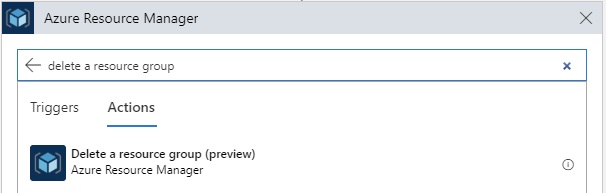
Next add an action for Delete a resource group (currently in preview at time of writing).

AzureRGSelfDestruct12

Fill in the following values:

  • Subscription:
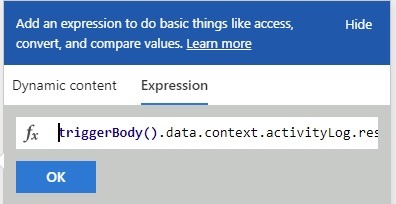
  • Resource Group: Expression = “triggerBody().data.context.activityLog.resourceGroupName”

AzureRGSelfDestruct7.jpg

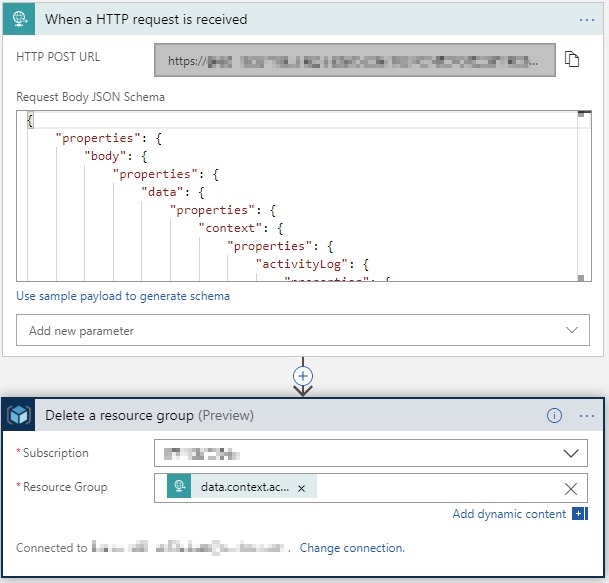
The final logic app will look similar to the following:

AzureRGSelfDestruct6.jpg

Test Solution

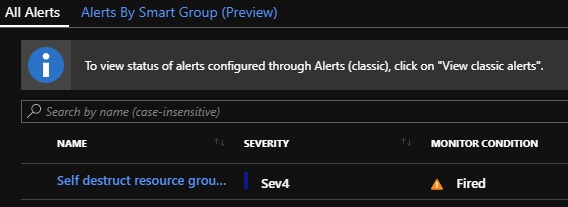
Test out the solution by adding a new resource group to the monitored subscription.  Check the Azure Monitor alerts to see if the Activity Log entry for successful resource group creation triggered the Logic App.

AzureRGSelfDestruct16

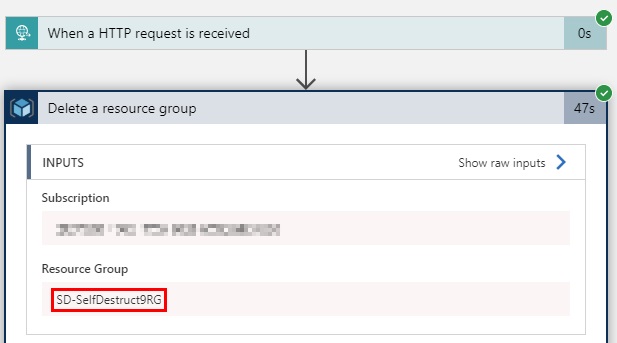
Then verify the logic app execution history shows the resource group deletion was successful.

AzureRGSelfDestruct15

Next steps

More than likely you will not want to delete the resource group right after you create it.  In that case you can add a Delay action which pauses the logic app for a specified number of minutes (ex. 60 minutes).  Additionally you could apply conditional logic to check if the name of the resource group matches (or doesn’t match) a specific pattern.  There are many additions you can add to personalize this solution to your needs.

Conclusion

In this post I walked through an adaptation of the Azure CLI extension that Mark Heath linked to.  We leveraged an Azure Monitor alert together with a logic app to provide an option to self destruct any resource group no matter where or how it was created.  If you have any feedback or additional suggestions feel free to leave them in the comments.

-Frog Out

Windows Equivalent of Linux or Unix “Touch” Command

In Linux and Unix there is a “touch” command which will update the timestamp of a file without modifying the contents.  You can also create an empty file without having to open an application among other actions.  In Windows there isn’t a direct equivalent, but you can get close by using the “copy” command with a “+” at the end of the filename while specifying no destination file.  The + symbol points the copy operation back to the source file.  This will update the timestamp while not modifying the contents of the file.

Ex.

copy SampleFile.txt+

WindowsEquivTouch1

WindowsEquivTouch2

This process was helpful for my customer testing out automated CI/CD processes with Azure DevOps and Git.  Hopefully this will be useful to someone else.  Enjoy.


-Frog Out

Sample Deploying Multiple Azure ARM Templates Using External Links

In this post I’ll share a set of linked Azure ARM templates (link) that can be used to deploy a number of Azure resources together.  This sample uses externally linked ARM templates using a parent to child relationship as well as including a few “complex” scenarios like conditional logic and assigning permissions through role assignments.  Note there are also two ways to deploy these templates: 1) at the subscription level (owner) and 2) at the resource group level (contributor).

<Update 2019-04-09>After reading this article on ARM template lifecycle management do’s and dont’s I’m rethinking using externally linked ARM templates.  Below example still contains them but I may update to combine into a single ARM template at a later date once I’ve had a chance to test.</Update>

Background

For a recent customer project we had a need to deploy the following resources.

  • Resource group
    • Azure Storage Account
    • Azure Function App
      • Azure Application Insights
    • Azure Log Analytics workspace
    • Azure Automation Account

A few of these resources have dependencies on each other such as the Function App requiring a storage account to store solution data into blobs / queues, Automation Account requiring Log Analytics for pushing diagnostic stream data to a workspace, etc.  While it is possible to deploy all of these resources in one (very) large ARM template, we also wanted to be able re-use pieces and parts of this solution in future projects that are going to have a similar (but slightly different) architecture.  We decided to create a set of parent-child ARM templates to mimic the first 2 levels of the above hierarchy.

Solution

The sample files are stored in my Blog-Samples repo under the ARM-External-Templates folder.  There is a brief README file to walk through the necessary steps to update parameter files, upload the linked templates to a storage account, etc.  This is not a fully documented process at the moment but if you wish to submit a PR or open an issue I’ll update more as I have time.

A few key pieces to highlight.

  • The “Contributor” scenario assumes that the deployment account has contributor permissions to a specific resource group or subscription (more common for production or similar environments)
  • The “Owner” scenario assumes that the deployment account has owner permissions to the entire subscription (ex. development environment)
  • The “Owner” scenario optionally deploys role assignments (queue sender, workspace reader, and runbook operator) to various resources only if the corresponding parameter values are not empty (otherwise skip assignment)
  • The Automation Account is pre-populated with a PowerShell runbook and also configured to send runbook job and stream output to the provisioned log analytics workspace

Sample output

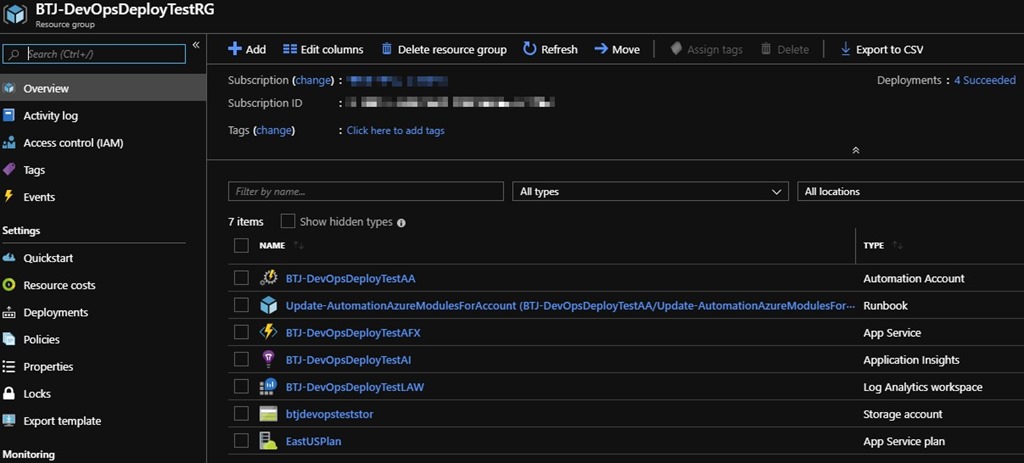
After running the deployment script the deployment and resource group should look as follows.

LinkedARMTemplates1.jpg

LinkedARMTemplates2.jpg


Conclusion

The linked ARM templates from this sample are meant for illustration purposes only.  Hopefully you’ll find them helpful in terms of what is possible from a deployment and configuration perspective.  If you have any feedback or suggestions please submit a PR on the repo or open an issue on GitHub.  Good luck with automating your Azure deployments.


-Frog Out

PowerShell Script to Find Connectors from PowerApps Apps

In this post I’ll share a script I developed for a customer to find which connectors are used by which PowerApps apps.  Currently this is not something available through the Power Platform Admin Center.  Feel free to use this script as you see fit.  This script is provided as-is without any warranties of any kind.  If you update or adapt it and decide to re-post please provide attribution.

Script

Note: If you do not see the below Gist please refer to code at this location: PS-Get_PowerApps_App_Connections.ps1


Add-PowerAppsAccount
$environments = Get-PowerAppEnvironment
foreach($environ in $environments.EnvironmentName)
{
$apps = Get-AdminPowerApp -EnvironmentName $environ
$apps | Add-Member -MemberType ScriptProperty -Name Connections -Value {$this.internal.properties.connectionReferences.PSObject.Properties.Value.DisplayName} -Force
$apps | Select-Object AppName, DisplayName, Connections
}

Sample output

image.png

You may notice that the output contains a complex property for the Connections.  It has been some time since I worked with formatting output in PowerShell.  If you have an improvement to the formatting please share back suggestion and I’ll update the sample script.

-Frog Out

Looking Ahead To 2019

In this post I’ll look ahead at what I have coming up in 2019 and what I look to accomplish.

Background

In previous years I have typically blogged at the start and end of the year about my goals and retrospective.  In mid-2018 I started capturing a monthly retrospective (see How I Do A Personal Monthly Retrospective).  While I’m doing these personal retrospectives more frequently (monthly vs. yearly) they usually contain more personal things than I would feel comfortable sharing publicly.

Ahead in 2019

Baby number 3

The biggest thing I’m looking forward to in 2019 is that my wife Sarah and I are expecting our third child later this year.  We’re finally starting to share the news outside of our immediate family.  I’m very excited and happy that our family is growing and I look forward to sharing our love with our new baby.

Exercise

For the past several years I’ve been running a few 5k races, quarter marathon races, and obstacle course / mud runs.  This has been a good way to push myself to stay active and healthy.  This year I’ve already signed up for a 5k and an obstacle course race in the first half of the year.  I’ve already started training for both and it’s amazing how much better I feel physically and mentally after getting into a good workout routine.  I find that I have more energy and motivation to accomplish things and hope that I can keep this up in the coming months.

Faith life

My Catholic faith has always been a big part of my life, but this year especially is an important year as my wife is preparing to enter fully into the Catholic Church.  I’m proud to support her on her faith journey as well as continuing to raise our children in our shared faith.

Technical leadership

In 2018 I went through a program at Microsoft called Technical Leadership Development Program (TLDP).  The purpose of this program is to identify individual contributors (ICs, not a manager of people) and grow their technical leadership skills to make a bigger impact inside and outside the company.  While there were many takeaways from this program one of the big ones for me was the following progression of stages (starting at bottom and going up) for a technical leader:

Technical Leaders…

    • Stage 4 – Drive Impact Through Strategy
    • Stage 3 – Drive Impact Through Others
    • Stage 2 – Master Individual Impact
    • Stage 1 – Grow Individual Impact

 image

At the start of 2018 I would estimate that I was in the 2nd stage of mastering individual impact and not realizing (at the time) that the next stage was to move onto driving impact through others.  Note that this progression to stage 3 doesn’t require moving into people management.  Instead you can remain an individual contributor while still increasing impact through other people.  I tested the waters with this process through the 30 Days of Microsoft Graph blog series and a few other side projects.  I’m looking forward to continue this progression in 2019.

Reading books

Each year on average I read 2-4 books, usually during slow weeks around holidays when I can devote more attention.  In the past year I’ve found a number of great books in a number of topics including science fiction, religion, and technical leadership.  I should probably join a Good Reads program but have not done so yet.  Instead I usually end up hearing about a good book recommendation from a friend or coworker and then picking it up from the local library, borrowing from a friend, or similar.  I’m not always able to reserve time each day / week, but I do find that I sleep better when I read for at least 10+ minutes before going to bed.

Conclusion

These are the things I’m currently looking forward to in 2019.  Thanks to my mentor Sean McDonough for urging me to get this written.  I know much will change throughout this year, especially once baby #3 arrives.  Here’s to a successful start to the year and continued growth.  If you have your own goals or plans for the year please share in the comments.

-Frog Out