Reduced Blogging For A Few Weeks

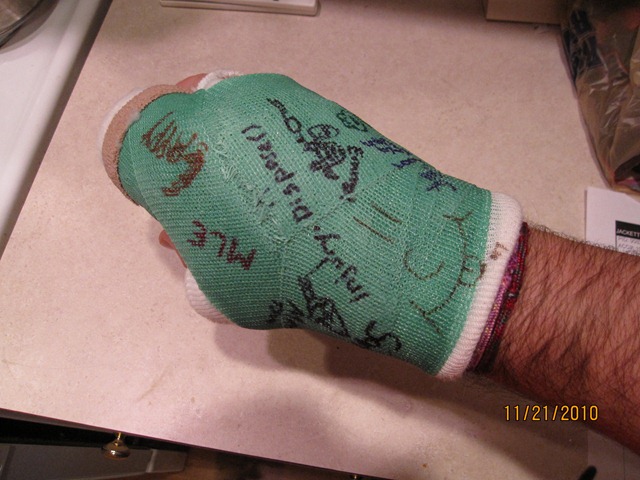
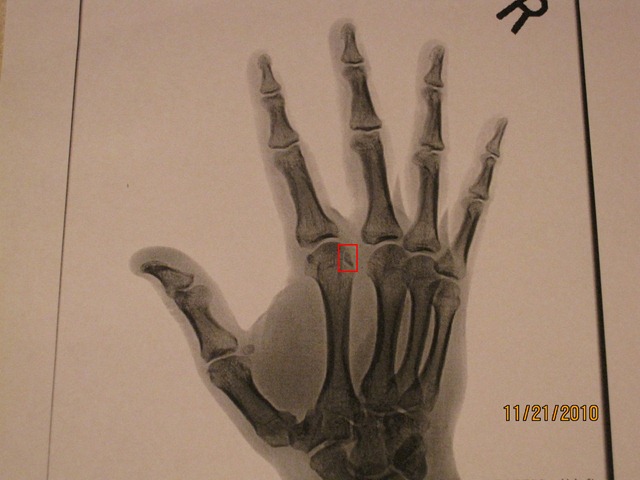
I typically post technical content on this blog, but I have a personal note this time around.  As some of you who follow me on Twitter or Facebook may know, last week I found out I fractured my right index knuckle and strained a ligament between my index and middle finger.  In order to heal this injury I’ll be wearing a cast for the next 3 1/2 weeks.  This is day 4 and I’m starting to get used to it, but my typing speed is still reduced and causes pain over long usage.  As such I am cutting back on a few side activities such as this blog, the SavePSToSP CodePlex project, and general research I do at nights.  I’ll still be responding to comments on this blog as they come up, but new content will be most likely be on hold until mid December when I get my fracture re-examined and hopefully can get rid of this cast for good.  Below is a copy of one x-ray showing the fracture and the other a shot of my cast today with some of the signatures I’ve collected.  I look forward to my hand healing and getting back to normal.  Have a fun and safe Thanksgiving holiday to all those that celebrate.
IMG_2174_adj IMG_2175


-Frog Out

PowerShell Script To Find All Closed Web Parts On SharePoint Site

Are your SharePoint pages loading slowly because you have numerous closed web parts eating up valuable resources?  Are you an admin tasked with tracking down those closed web parts?  Recently my friend Brian Gough asked me a fairly simple question: “Is it possible to use PowerShell to find all ‘closed’ webparts in a site collection?”  In this post I’ll show you a short PowerShell script that will identify all closed web parts on a site and it’s sub-sites.

Solution

The script below uses an advanced function (requires PowerShell V2) to search within a SharePoint and it’s sub-sites for all instances of closed web parts on all pages.  I use the SPLimitedWebPartManager associated with each page within the SPWeb object to get a reference to the web parts.  Since I am using the SharePoint API (loaded in the Begin block) directly you can run this against both SharePoint 2007 and 2010 (Note: only tested against SharePoint 2007 so far).  If you are running PowerShell V1 you can run just the code inside the function by itself and provide a site URL manually.

Click here to download the script.

function Search-SPClosedWebParts

{

<# 

 .Synopsis

  Finds instances of closed web parts on SharePoint site and sub-sites.

 .Description

  Finds instances of closed web parts on SharePoint site and sub-sites.

 .Parameter

  SiteUrl

  SiteUrl to search for closed web parts

 .Example

  Search-SPClosedWebParts

  Finds instances of closed web parts on SharePoint site and sub-sites.

#>

[CmdletBinding()]

param(

    [Parameter(Mandatory = $true, valueFromPipeline=$true)]

    [String]

    $SiteUrl

)#end param

    Begin

    {

        [void][System.Reflection.Assembly]::LoadWithPartialName("Microsoft.SharePoint")

    }

    Process

    {

        $site = new-Object Microsoft.SharePoint.SPSite($SiteUrl)


        $site.AllWebs | ForEach-Object {

            $currentWeb = $_

            $pages = $currentWeb.Files | Where-Object {$_.Name -match ".aspx"}


            $pages | ForEach-Object {

                $currentPage = $_

                $webPartManager = $currentWeb.GetLimitedWebPartManager($currentPage.ServerRelativeUrl, `

                    [System.Web.UI.WebControls.WebParts.PersonalizationScope]::Shared)


                $webPartManager.WebParts | ForEach-Object {

                    if($_.IsClosed)

                    {

                        Write-Host "'$($_.Title)' on $($currentPage.ServerRelativeUrl) is closed"

                    }

                }

            }


            $currentWeb.Dispose()

        }


        $site.Dispose()

    }

} #end Search-SPClosedWebParts


$siteUrlToSearch = Read-Host -Prompt "Enter site URL to check for closed web parts"


Search-SPClosedWebParts -SiteUrl $siteUrlToSearch

FindClosedWebPart1

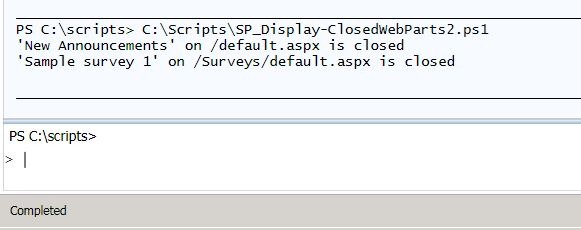
Screenshot output from calling script

Conclusion

Using the SharePoint API and some basic looping structures I demonstrated a short script that can quickly and easily identify web parts that have been closed.  If desired you could modify the script to also automatically delete these closed web parts.  Since we are only concerned with finding instances of closed web parts I have left that functionality out for now.  Feel free to use and adapt this script as you like, but please attribute the original source if you re-publish or distribute a modified version.  Now go enjoy all that extra time you’ll have from not having to manually track down all those closed web parts.

-Frog Out

Links

Display closed web parts PowerShell Script

http://cid-9137d132751b949f.office.live.com/self.aspx/.Public/Blog%20files/SP%5E_Display-ClosedWebParts2.ps1

Slides from Dog Food Conference 2010

    At the Dog Food Conference 2010 I presented a session titled “SharePoint 2010 and Integrating Line of Business Applications”.  In this session we covered the basics of the Business Connectivity Service (BCS) in SharePoint 2010 and went through a number of demos on how to develop against it.  Click here for my slides.  Thanks to all who attended and had some great questions and interactions.  If you would like more BCS resources or have any feedback on this presentation feel free to leave comments.


      -Frog Out


Links

“SharePoint 2010 and Integrating Line of Business Applications” Presentation slides

http://cid-9137d132751b949f.office.live.com/view.aspx/.Public/Presentation%20Files/Dog%20Food%20Con%202010/SP2010%20Integrating%20LOB%20Apps.pptx